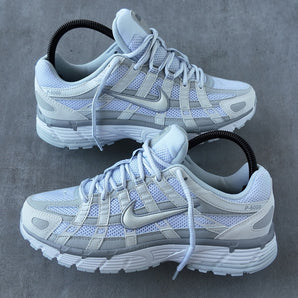

Quick answer: most buyers should start with their usual Nike size. Published fit evidence leans true to size, but foot width, sock thickness and heel hold can change the result. If you are between sizes, use your heel-to-toe measurement rather than copying a size from another Nike model.
Check current Nike P-6000 sizes
Use this guide to choose a starting size, then compare the UK sizes and colourways that are actually available.
Nike P-6000 sizing at a glance
| Your fit situation | Best starting point | What to check |
|---|---|---|
| Regular-width feet | Your usual Nike size | About a thumb's width at the toe and secure heel hold. |
| Between sizes | Compare heel-to-toe centimetres first | Choose the option that gives toe room without heel slip. |
| Wider forefoot | Try your usual size before assuming you must size up | If the sides pinch, compare the next half size while checking heel security. |
| Narrower feet | Your usual size with secure lacing | Only consider sizing down when there is excess length as well as heel movement. |


How does the Nike P-6000 fit?
Length
The most useful starting point is your normal Nike size. RunRepeat's published fit-vote summary currently leans true to size, so there is no evidence-based reason to tell every buyer to size up or down automatically.
Toe box and width
The mesh can flex, but the synthetic overlays still give the upper structure. Independent lab measurements describe the tested pair as around a medium-width shape. Wider feet may need more room, yet sizing up is only helpful if it does not leave too much length or heel movement.
Midfoot and heel hold
The overlay and lacing layout can feel more secure through the midfoot than a simple mesh trainer. When trying a pair, walk on a clean indoor surface and check whether the heel lifts before deciding that extra width alone makes the larger size better.
How to measure before ordering
- Measure both feet near the end of the day while wearing the socks you expect to use.
- Stand with your heel against a wall and mark the end of the longest toe.
- Measure the longer foot in centimetres.
- Compare that measurement with Nike's current size chart, then allow for your preferred toe room and width.
Measurements are more reliable than transferring a UK size from a shoe with a different last or upper construction.


Nike P-6000 sizing compared with Dunks and Air Force 1
Do not assume that the same tagged size will feel identical across all three models. Foot shape and personal preference create mixed reports, so these comparisons are decision checks rather than fixed conversion rules.
| Model you already wear | How to use it as a reference |
|---|---|
| Nike Dunk | Use it as a rough length reference only. The P-6000's mesh-and-overlay upper can hold the midfoot and forefoot differently, so compare centimetres and heel movement. |
| Nike Air Force 1 | Air Force 1 is often described as roomier, but individual reports vary. Do not automatically transfer the same UK size without checking the size chart and the space in your current pair. |
Common P-6000 sizing mistakes
- Automatically sizing up for wide feet: extra length can create heel slip without solving the pressure point.
- Using only another model's UK size: compare centimetres because shoe shapes differ.
- Trying with the wrong socks: thicker socks can noticeably change a close fit.
- Ignoring both feet: use the longer foot as the practical reference.
Nike P-6000 sizing FAQs
Do Nike P-6000 trainers fit true to size?
Published fit evidence generally points to true-to-size length for most wearers. Start with your normal Nike size, then assess width, toe room and heel hold.
Should wide feet size up in the Nike P-6000?
Not automatically. Try the usual size as the starting point and compare a half size up only if the forefoot feels restricted. The larger option should not cause heel slip or excessive length.
Should I buy the same size as Nike Dunks?
Use your Dunk size as a reference, not a guarantee. The uppers and internal shapes differ, so compare heel-to-toe centimetres and how securely each model holds your foot.
Should I buy the same size as Air Force 1?
Do not assume an exact match. Air Force 1 can feel roomier for many wearers, but reports vary. Check Nike's current size chart and the spare room in your existing pair.
Fit evidence checked against RunRepeat's published P-6000 fit and lab data and Nike's footwear size guidance. Fit remains individual.
Compare the sizes currently in stock
Once you have a starting size, use the collection to compare live availability across current P-6000 colourways.